Got it. See it now. Let’s talk about it, as you have there a lot of “thingies” that I would not classify as emotions. Here is my analysis of Amelia’s and Wojtek/Jan codebooks. My goal was to fish out all “emotional” codes. I tried to stay close to the standard (more or less) classification of emotions (see some explanations below).
Emotions and related codes (let’s discuss both lists):
Jan (started July 3, 2020)
Amelia’s codes
42 – intense feelings
48 – feeling at home
54 – emotional distance
69 – happiness
78 – emotional distress
103 – emotional distress
105 – loneliness (this is a state, not emotion – my therapist friends remind me though)
114 – empathy
182 – hate
183 – fear
191 – anxiety
266 – eliciting emotions
269 – feeling of safety (Is it an emotion or rather attitude/personal assessment/view?)
270 – feeling unsafe
274 – fear (repeat of 183)
276 – unfunded fear
277 – sense of danger (Amelia: potentially merge with 270 “feeling unsafe”)
295 – feeling of missing out (“FOMO”)
319 – emotional attachment
340 – grief
341 – empathy (repeat of 114)
Additional remarks
168 – rituals – refine description? Not just repetitive (as in Goffman) but set apart from the everyday (as in van Gennep and Turner)
302 – rituals (again)
Wojtek and Jan’s codes
12 – justified anger [Should it be just “anger?]
16 – eversion (to flaunting homosexuality) [in Plutchik’s wheel (PW) below – disgust, I suppose].
35 – despondency
36 – disappointment
50 – gratitude
51 – (growing) empathy [BUT: It is a method of obtaining knowledge, not emotion]
55 – hatred [contempt in Plutchik’s wheel?]
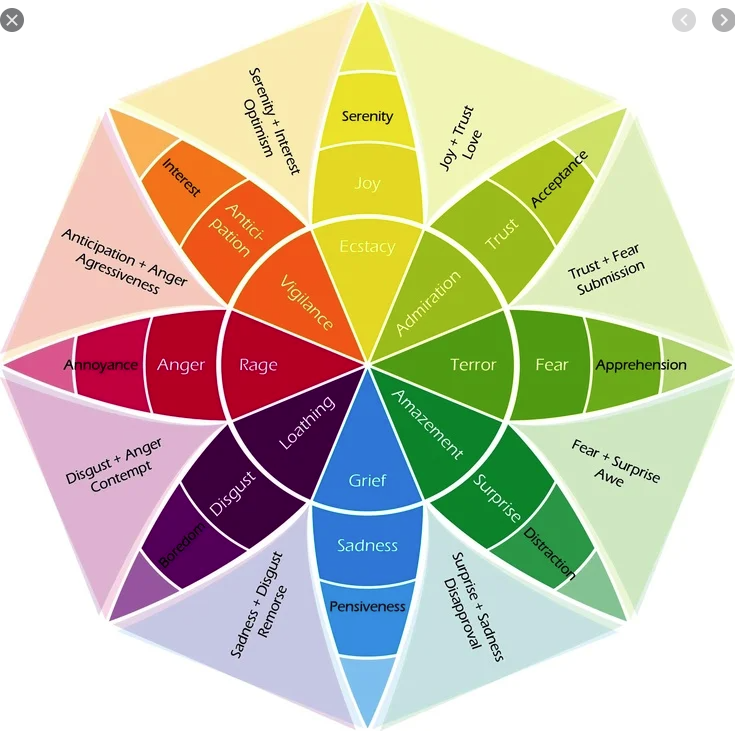
76 – liking (job) [in Plutchik: admiration + trust = acceptance]
77 – little happiness [Plutchik: joy]
115 – positive sentiment [Plutchik: serenity + interest = optimism]
157 – toxic masculinity (Is there any emotion here or just/mostly listing a specific form of masculinity?)
In my studies on emotions, I have come across the diagram I copy below. Also, I have the full e-version of a handbook of psychological anthropology, written by one of my favourite teachers at Columbia, Chuck Lindholm, Culture and Identity. The History, Theory and Practice of Psychological Anthropology. I will gladly share, should you be interested. I take the diagram below (Plutchik’s wheel) from that book (2007:275)
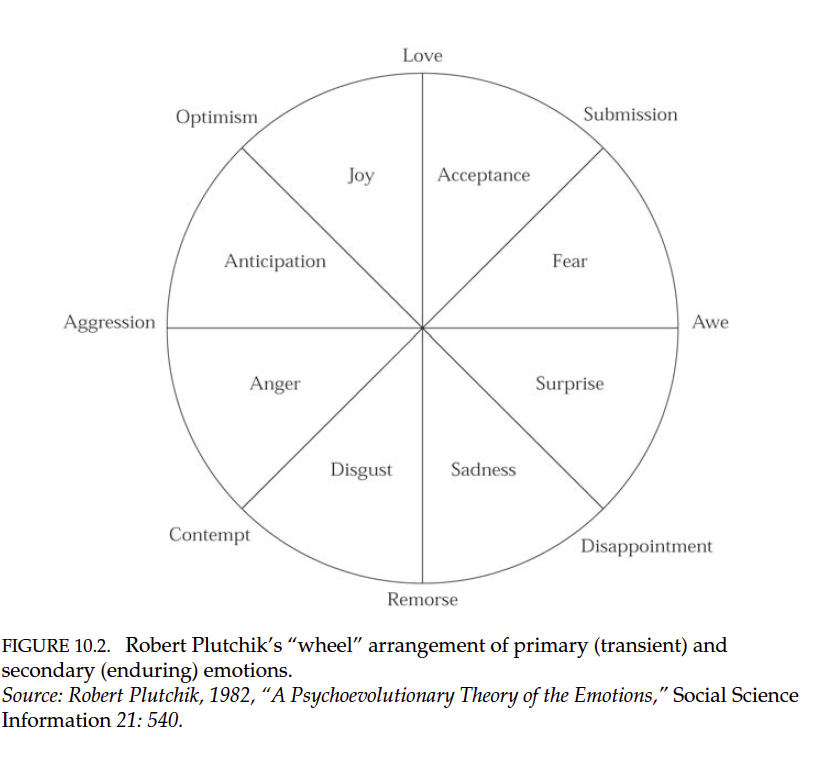
See also: The Emotion Wheel: What It Is and How to Use It (and another version of this diagram below):
Summary of the section on emotions (Lindholm 2007:291)
Emotions are, as any number of theorists have noted, extremely difficult to study. Compelling, ambiguous, and subjective, they have served in the West as the epitome of the irrational. But they are also perhaps the most powerful motivating factors in our lives, and so have been the object of intellectual discourse for a very long time indeed. Many theories of emotion have been proposed, some of them concerned primarily with evaluation, others with typology. Emotions have also been the object of rational control, and have been apostrophized as the seat of true humanity. They have been seen as internally generated and as completely reflective of context.
Despite controversy, it is now recognized that emotions do have distinctive and universal physiological content, that they serve as a biological system of motivation. It is also recognized that some emotions are fundamental and powerful, while others are peripheral and less gripping. But exactly what these fundamental emotions are remains controversial, though there seems to be general agreement that fear, anger, sadness, and happiness ought to be included (emphasis - JK).
Some anthropologists have been slow to accept these findings and have tended instead to argue that emotions are completely culturally constructed. The Balinese, for example, have been said to have no feelings at all, while the Inuit feel no anger and the Ilongot can throw anger away. Yet restudies have discovered that these are overstatements that do not do justice to the complexity of the emotional experience of these peoples. It is clear, though, that emotion is regulated differently in various cultures, with some strongly favoring masking or even simulating emotions for pragmatic purposes, while others alter their expression of feeling in the belief that this will change their inner reality. These differences are related to differences in social structure: Tight yet competitive structures where people have a known status and role are more likely to manipulate or mask feeling; looser and more ambiguous systems lead members to define themselves through the public expression of appropriate emotional states.
But if different societies have different concepts of emotion, does this mean that feelings themselves differ? Many anthropologists now argue that some cultures do not see emotion in Western fashion as internal, personal, and powerful. Instead, for them, emotion is public, relational, and controllable—an embodied form of thought. However, there are contradictions in this argument—not the least of which is the difficulty of accounting for the motivations of others in ways that do not simply reduce all interactions to quests for power. Also, conflating thought with emotion has the unintended consequence of reducing the autonomy of emotion. Feeling becomes another mode of discourse and thus all but disappears.
What is needed instead is a more dialectical view of emotion and culture as realms of being that are intertwined and mutually interrelated, but do not wholly overlap. Some emotions may be hypercognized, others may be hardly spoken of at all, yet the latter do not vanish and may appear in symbolic or somatic forms. Certainly, culturally specific emotional forms do indeed exist, as blends or as modifications of deeper drives. Nonetheless, for the anthropological study of emotion to go forward, it must be admitted that all human beings share a common heritage. To argue that fundamental emotional impulses exist and are engaged in a dialectic with cultural constraints does not undermine anthropological analysis. Instead, this premise provides a better basis for comparative work and, perhaps more importantly, gives a basis for the humane anthropological claim that others are not so different from ourselves. They too are driven by contradictory desires for attachment and for autonomy; they too are subject to fears, anxieties, and grief; they too are transported by love and communion.