Taking temperature on future facilitation

Hello @reef-full @reef-associate

I have been reflecting on how to handle future facilitation during the plenaries.

This post is meant to share my current thoughts and take temperature on a potential way forward.

Context

As our project is entering the next phase we will be working on creating a requirements document with the architects. The board has indicated a concern that we will be taking a lot of decisions with little time to decide. The current decision-making format might not be good enough to keep up with the work.

The purpose of the consent methodology we apply is to make decisions, based on proposals, that are within our range of tolerance. As well as use collective intelligence to unearth objections. I.e. real risks that jeopardize the project, or group if we accept a certain proposal.

During yesterday’s refresher on working methods, we remarked that we rarely object to a proposal, although we do spend a lot of time talking about concerns and sharing thoughts. I think this process holds emotional value, and yet spending a lot of time on thoughts and concerns might not be the best way to decide.

In my professional context we do our best to apply consent methodology as well. There is a big difference in how we apply it though.

In my work the flow looks like this: Presentation of the proposal => clarifying questions rounds => objection rounds => if all objections are dealt with a proposal is consented to => concerns rounds.

So, concerns only come at the end of the process because they are actually not relevant to the consent decision.

Proposal
Based on this experience, could we try something similar for consent level decisions in future plenaries?

In practice it would mean:

  1. A proposal gets presented
  2. A round of clarifying questions to make sure we understand the substance of the proposal
  3. An objection round. The prompt would be: is the proposal in your range of tolerance, if not what are your objections
    3.5 Resolve the objections (measure the objection, shorten the term, amend the proposal)
  4. Consent
  5. Further thoughts and concerns only if there is time left for the topic

This way we could prioritize efficient decision making and leave space for personal concerns if time allows is.

Poll

Based on this explanation, is my idea understandable, and would you be willing to try this approach in a future plenary? The outcome of the poll isn’t binding it is just a way for me to know where people stand with regards to this idea :slight_smile:

  • I don’t understand what you are proposing
  • I love this idea
  • I don’t think this is a good idea
  • I would like to try this out
0 voters

You can select multiple answers.

You can also provide feedback in this thread!

Could you kindly fill in the poll by 23/10

Sorry, not sorry for the wall of text :heart:

5 Likes

Thanks Gaultier, but aren’t the concerns a sort of preamble to potentially object to something?

Even if it doesn’t happen in reality. It kind of sounds like ā€œwe will consent, irrespective of concernsā€.

I don’t mind trying it out, but I am not sure if this means disregarding concerns.

4 Likes

If we do opt to try this out, it will be necessary to do so with a few different proposals, ideally with differing levels of complexity, importance, etc., so as to get a good idea about the benefits and/or limitations of the process…

4 Likes

I’m interested in this experiment !

Also, another variable we have control over (in addition to how long it takes to make a decision) is how many decisions are made in plenary. It seems like sociocracy also allows for teams to have more autonomy / decision making power than we currently give them. Maybe it would be interesting for teams to pick up some slack, instead of putting it all on the plenaries.

As for the mass of design decisions coming our way (what we want common spaces to look like / if we want outlets here, a sink there), I have always seen this handled with a dedicated, weekend-long workshop facilitated by cohousing professionals. But then, my perspective is inherently biased, as I am married to someone who does that for a living, and those most of the projects I’m exposed to.

3 Likes

Happy to try it out, and echoing these comments that were made by Maria, Chris and Daniel:

4 Likes

Hi @GaultierDWM,

I don’t find an option in your poll that expresses my position, so here’s my feedback …

I’m not opposed to the idea, and I would be ok to try it out when we have some innocent decisions to be made. I’m sure I’d be comfortable to try this out on an important decision right away.

More importantly I would like to take a step back, and have a look at the problem we are trying to solve, and possible solutions that we have at our disposition to try it. Ideally I’d like to discuss these in a Team Facilitation meeting, but I understand the time constraints we are facing.

The problem we are trying to solve (as I see it): we have been facing timing issues lately when trying to get to a decision.

Possible solution no 1: we reduce the time for questions. In some of the last meetings we have gone through endless amounts of questions, sometimes going for an academic level of understanding, sometimes also repeating what had already been said in the previous meeting.
Things a facilitator can do:

  • Make it very clear that we are only welcoming questions that are needed to consent to the proposal.

  • Make it clear that a question has already been clarified in the previous meeting.

  • Limit the number of questions to one per person per round. If then at the end of the round there are still some burning questions, we can make space for that, but I think this system is fairer and it will put a constraint on the urgency to go to a full understanding of every little detail.

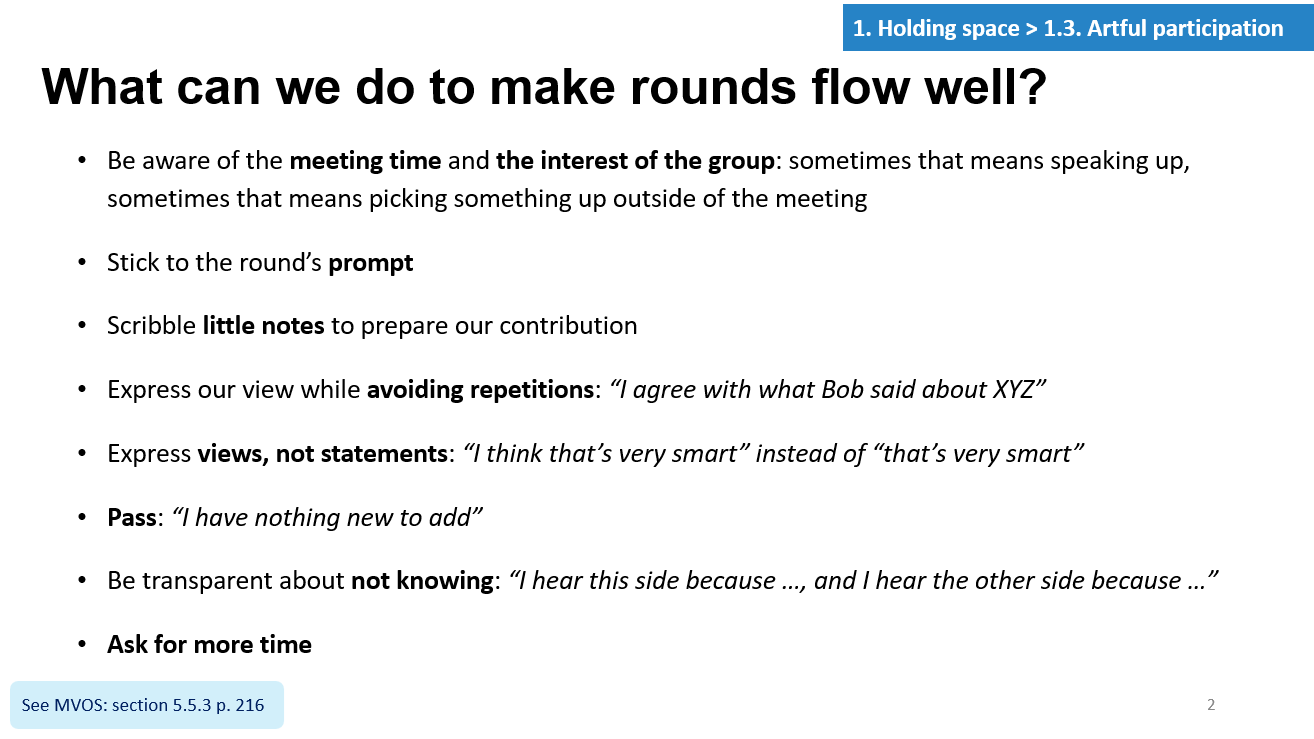
Possible solution no 2: we encourage everybody to take responsibility for the time that we have available. We might point to the slide from our facilitation training on ā€œartful participationā€ in sociocratic meeting (screenshot below).
Things a facilitator can do:

  • Remind everybody of the time available.

  • Remind people that it’s ok to pass or keep it very short - ā€œI have nothing to addā€ is a great contribution, so is ā€œI agree with XYZ on ABCā€.

  • When somebody says ā€œI don’t really have anything to say about thisā€ and then starts waffling for more than 5 minutes, interrupt that person and ask them to come to the point, if there is any.

Possible solution no 3: ask people to be clearer on whether they are sharing a concern or an objection. I personally think there is value in sharing concerns after the round of questions - which is why I am not super enthusiastic about your proposal. Asking people to be clearer on whether it is a concern or an objection will help the facilitator to see whether there is something that needs to be addressed yes or no.

Some of these solutions require a bit of courage from the facilitator - not everybody will always feel joyful about it - but then I think that’s the responsibility we are signing up for. If I can choose between trying any of these alternative solutions and skipping people’s concerns before making a decision, I have a clear preference for the former.

6 Likes

I’m down to try it out, and I have a suggestion: how about using sideways thumbs as an option to say ā€œI consent but have concernsā€. If everyone, or many are sideways, that might suggest that the proposal isn’t good and might need more work, even if nobody blocks it. But that would be the facilitators role to decide, based on the context.

If we use this sideways option, the facilitator needs to make VERY clear that a sideways thumb is still a consent, and a consent still means ā€œI will help implement this proposal and respect this decisionā€. It should not be used as a way to cop out if a decision.

3 Likes

This works well, but scales poorly. Attendance is way down. People are likely tired: if that’s true adding decision time is not a real solution, because not everyone has time to add. I would rather explore prioritizing decisions: most decisions go to helping circles, almost everything that comes out of a helping circle is approved quickly with minimal or no plebary debate, a few strategic decision are taken to plenary or even workshopped, but then people know which meetings they’d better not miss. Something like that.

3 Likes

There is a hand signals manual that we put together quite a while ago now: Login – Nextcloud

It was always meant to be a ā€˜work in progress’, with the thinking being that we would need to use hand signals more as the group got bigger, in order to make the facilitation more efficient… :slight_smile:

4 Likes