This proposal comes with slides.
Background
As we hardened The Reef’s budget in 2025, we made a decision to not budget anything at all for solar panels. Instead, we would entrust a different legal entity, an energy community under European law, with financing, building and running production and consumption of solar energy in The Reef.
In late 2025 we started a helping circle (HC) to explore the technical and financial aspects of a possible energy community.
What we did
The HC contacted the Brussels Region’s Facilitateurs d’Energie. We:
- Asked them questions to build a general picture (legal options, formalities, prerequisites…)
- Asked them for technical information to simulate the economics of installing the equipment for solar energy production in The Reef specifically. The simulations were built on the basis of data we acquired from Walk (example: how many solar panels will fit on The Reef?) and from the Facilitateurs themselves (example: what is the value of the Green Certificates that the Brussels region will reimburse against the production of 1 kWh of solar energy?). We fed that data into a simulator created by the Facilitateurs (an Excel sheet with a macro).
Results
Legal and organizational
- In the context of The Reef, an energy community is an arrangement whereby all Reeflings would agree to mutualize the production and consumption of energy. We are calling this arrangement Torpedo. Some of us would be investors in it, contributing to financing the upfront cost of the panels. All of us, including the tenants, would be consumers. The consumers (individual Reeflings) pay Torpedo (expression of the collective of all Reeflings) for the energy they consume, so that Torpedo is making money. For the first few years, that money is used to pay back the initial investment; after that it becomes a surplus. Please note that “investors” is not the same as “owners”. We imagine a situation in which all Reeflings own Torpedo collectively and buy electricity from it, and investors are in fact lending money to Torpedo, who pays them back.
- Running an energy community requires creating a legal entity, so some paperwork is involved both for creating it and running it once it was created.
- The Reef most likely fits into the simplest case, that of an energy community within the same copropriété (the final decision on this is made by Sibelga). In that case, and limiting membership to Reeflings only, an ASBL would be sufficient.
- We consider that the organizational load is very reasonable, nothing compared to what we are carrying now.
The facilities
-
The Facilitateurs recommended to go with Walk’s scenario of 86 panels, generating 35 kW at peak.
-
They also recommended to not invest in batteries for the moment, as (1) the economics are not that attractive given we would only be about 25% self-sufficient and (2) batteries technology is quickly improving, so we can reconsider during construction or even later. However, see below for considerations about resilience. In any case, the no-batteries scenario is a baseline.
-
The other critical piece of technology is the smart meters for all units and the commons, co-located in the same local technique in Obelix. This was already in the plans.
-
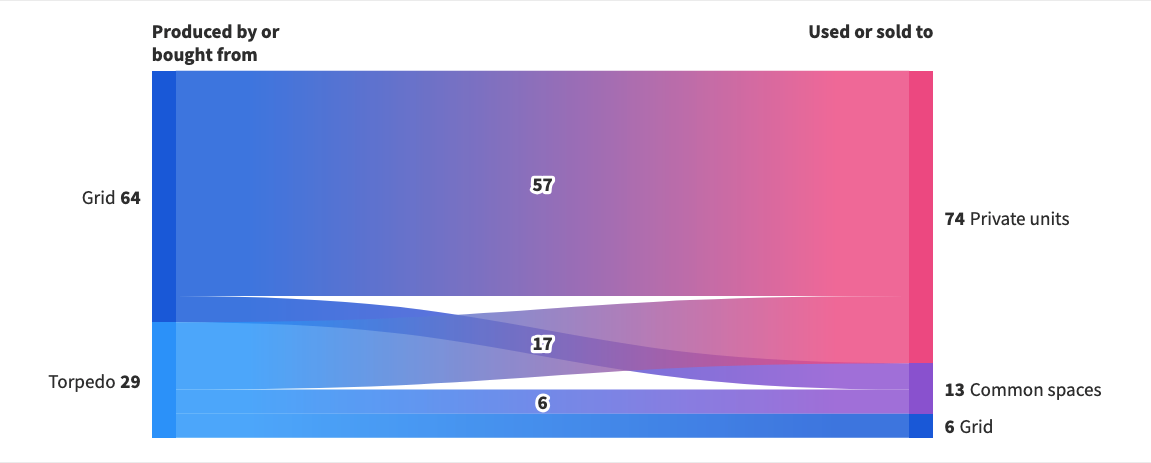
In this scenario, we estimate the entire yearly consumption of The Reef in about 74,000 kWh for private units, plus another 12,750 for the common spaces. It is very low because of high-quality insulation. Of these, 23,130 would be produced by our own solar panels. About half of our commons’ consumption (common spaces lighting/heating/cooling/cooking, washing machines, lifts) and part of our private consumption would be covered by locally generated power.
-
Our own production would be around 29,240 kWh. We would use 23,130 of these ourselves, of which a bit over 6,000 for the commons and about 17,000 for private units, and sell back to the grid the rest. Savings are highest for the kWh used in the commons, as this is considered full auto-production and is not subject to network usage fees. kWh used in private units are subject to network usage fees, but these are lower than those levied on the electricity we buy from the grid.
The Sankey diagram below shows where energy comes from (left) and where it goes to (right). The numbers in the diagram are expressed in megawatt/hours x year. In percentage terms:
Of the energy we produce:
- 21 % of the energy we produce goes to the commons.
- 58 % goes to private units.
- 21 % we won’t use and sell to the grid. This is the part we could theoretically recover with batteries.
Of the energy we consume, the percentage generated at home is
- 26% overall
- 50% of the energy used in the commons.
- 23% of the energy we use in the private units.
Economics
The economics of the operation depend on:
- Electricity market price. The higher the price, the more attractive the energy community. For the purpose of the simulation, the price of a kWh - inclusive of VAT and various fees - is 33.37 cents. The war in Iran is VERY likely to drive this price up, perhaps substantially. That makes our estimation conservative with respect to the installation of panels.
- Up-front investment costs. Currently estimated at about 41,000 EUR. The higher the costs (for a given peak power), the less attractive the energy community. Advances in solar panel technology make it unlikely that this number will go up by much; in fact, modulo the war in Iran, it should go down, even by a lot in the medium term.
- Green certificates. These are straight-up subsidies to solar panels. They consist in a fixed amount per kWh of power produced per year, over 10 years. The higher the subsidy, the more attractive the energy community. Our simulations are based on the value of the green certificates in the Brussels region for 2026. However, these are administrative decisions, and this value might change, even significantly, before we get to install our own panels.
- Feed-in tariff. This is an administered price that Sibelga pays to the owner of the solar panels per kWh fed into the grid. Currently low (2 cents per KwH). Formally, the higher the feed-in tariff, the more attractive the energy community, but in practice the current levels would need to change by a lot to make a real difference.
More details
-
As the energy production of the solar panels will be connected to the common counter, the energy produced by Torpedo and used for the commons won’t pass over the network and will thus be free of taxes and fees.
-
What is not consumed by the commons will be injected onto the regular network. Thanks to this energy community though, the fees and taxes we will pay related to the energy bought from Torpedo will be lower than the fees and taxes linked to the energy bought of the regular electricity provider, which brings in fact a double advantage.
-
We did three simulations
- 1st simulation (blue part on the simulation file), using a total electricity cost (including taxes and fees) that corresponds to the regular electricity cost (including taxes and fees)
- 2nd simulation (green part on the simulation file) using the electricity cost of the social tarif (without taxes and fees). This cost is 10,84 eurcent/kWh
- adding the normal taxes and fees you come to a total electricity cost of 25,28 eurocent/kWh
- adding the energy community taxes and fees, you come to a total of 19,16 eurocent/kwh + an annual fee per household of 16,84 euro/year
3rd simulation (purple part on the simulation file) using the electricity cost of the regular tarif (without taxes and fees). This cost is 15,9 eurocent/kwh - adding the normal taxes and fees, you come to a total electricity cost of 33,37 eurocent/kWh
- adding the energy community taxes and fees, you come to a total of 24,22 eurocent/kWh + an annual fee per household of 16,84 euro/year
-
On line 17 you can see the different ‘saving on electricity bills’, depending on the simulation scenario, depending if you are an owner of a big unit (113 m2) or small unit (66 m2) or if you are a tenant of a small unit
Results
- In the current price landscape, energy communities are a way to save money.
- In an arrangement like Torpedo, the precise shape of the savings depend on the internal price charged by Torpedo to the Reeflings. If the price is close to the market price of electricity, individual Reeflings do not save much, but Torpedo as a collective vehicle makes a nice revenue. This means that it can quite quickly repay the initial investment and start making profit. Viceversa, if the price is low, the savings of individual Reeflings are substantial, but it takes a longer time for Torpedo to pay back its investments and start producing a surplus.
- We used the simulator provided by the Facilitateurs to create different scenarios, from “everyone pays the social tariff of 25.28 cents x kWh to maximize individual savings” to “everyone pays as much as they would on the regular electricity market to maximize collective savings”, The results are very encouraging: owners-inhabitants of larger units would save from 148 to 240 EUR per year; tenants of smaller units, from 67 to 148; Torpedo would pay back the solar panels in 5 to 7 years, assuming that the Green Certificates scheme stays the same. You can access the scenarios here.
- In addition to the predicted savings, the energy community has a large advantage in reducing the geopolitical uncertainties around energy. Not only on prices, but even on availability itself. Even during a blackout, our own panels will still work, and provide some power. About half of what we need in the summer, only a little in the winter, but that much will be there, independent of Putin, Trump, AI data centers, and whatever nonsense global finance has dreamed up this week.
- In conclusion, the HC considers that that an energy community is a good idea for The Reef. it has financial advantages; it has advantages for resilience and our own peace of mind. These advantages are not likely to disappear in the coming years, and if anything are more likely to even become more marked.