Introducing Dikkenek: homegrown AI from Brussels

Dear @reeflings, @TamaraFoubert and I – under the vigilant eye of @yudhanjaya , supervising us from Sri Lanka – embarked in an experiment that could hopefully give The Reef some AI capabilities in line with our EU-first, opensource, dependence-reducing, environmentally conscious approach to computation. Inspired by permacomputing and concerned about the large environmental and social impact of data centers powering AI, I turned to @hugi , who suggested locally run AI, and to Yudha, who suggested a “junkyard science” approach to Hugi’s idea.

So, under Yudha’s guidance, I purchased about 1,000 EUR of materials to build a computer – a steal given current prices of the kind of RAM that, being good at matrix multiplication, is good at the inference that AI is based on. The jewels of the crown are the two (second-hand) AMT Radeon VII GPUs, that do the computational heavy lifting. Tamara took care of assembling those pieces into a functioning machine. Yudha provided the software that handles the models (mostly fairly small Chinese open weight models), the interface and the harness with the permissions etc.
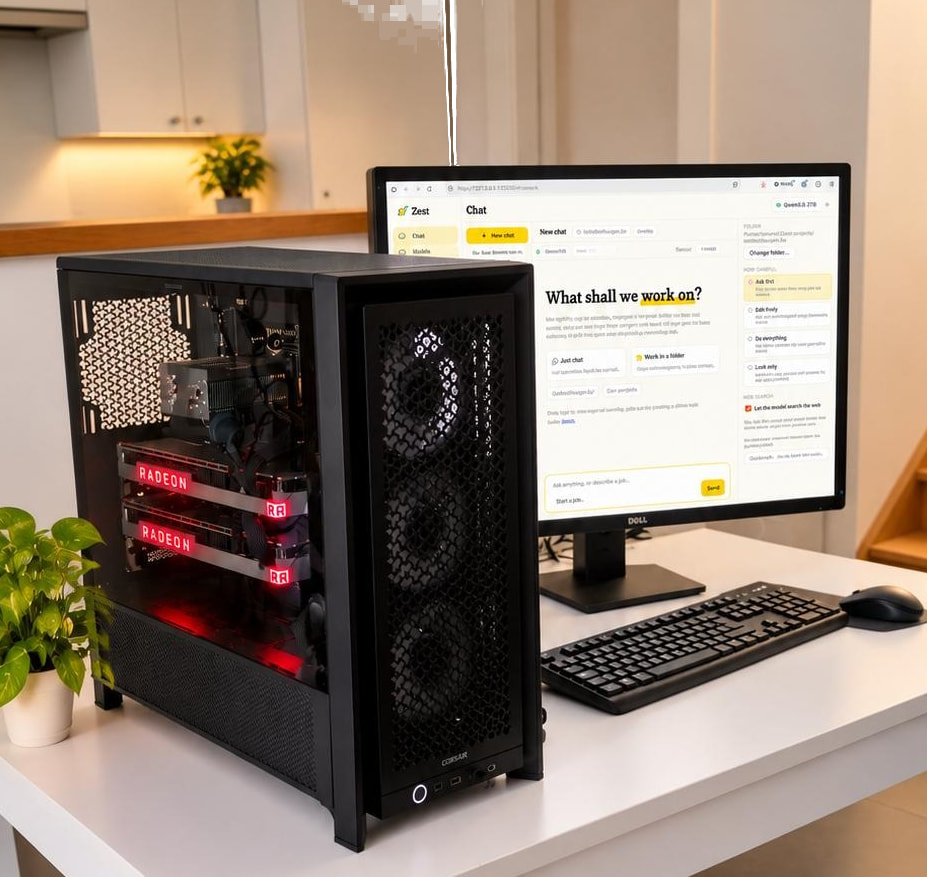
We are calling it Dikkenek, and once we get around to creating our own agent I plan to give it a Dikkenek-like personality, which I think is appropriate for a brusselaar AI. The idea is to make it accessible over the internet, so it will be our own little data center, fully powered with renewable electricity. In perfect Dikkenek style, we are already bragging about the machine, though it has not actually done anything useful yet: an inspired move by @Lee resulted in De Standaard briefly interviewing us for a forthcoming article about “Belgian organizations refusing to use American AI”. Not sure she will use our example though.

Testing is ongoing. Among the tests, I plan to use it the next time we need to produce documents to exchange with our various architects, engineers, notaries, etc. Of course, all of these are always reviewed by humans, but occasionally we use AI to produce a first draft. Tamara and I will keep you posted. Hey, if everything fails I will have a powerful gaming machine.

Huge, huge thanks to all who advised, inspired, and sweated on this project. I am counting on you to hang in there, there is still much to explore.

13 Likes

Oh, oh, I want to be closer to this machine. How is it holding up?

3 Likes

@TamaraFoubert is spending a lot of time with it. Ask her, or visit :slightly_smiling_face:.

1 Like

So inspiring for the future, congrats!!!

1 Like

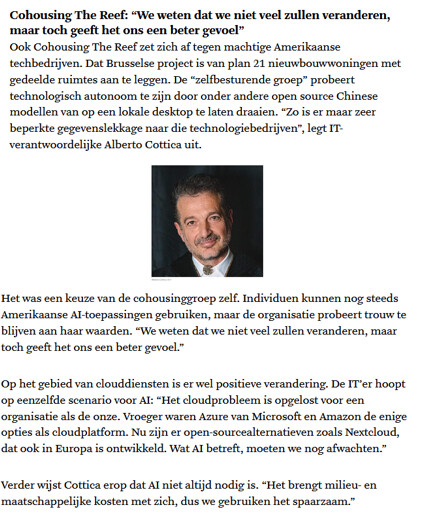
For the sake of completeness a link (paywalled though) to how Dikkenek almost made it to the newspaper: https://www.standaard.be/economie/chatgpt-deze-bedrijven-werken-liever-met-europese-ai-loskomen-van-amerikaanse-systemen-vergt-veel-moed/163609708.html

And here’s a screenshot:

5 Likes

Logged in after a while!

We have, in total, four machines to test and build on:

  • Dikkenek: an Intel(R) Xeon(R) CPU E5-2697 v2, 128 GB of DDR 3 RAM, two AMD Radeon VII GPUs for 32 GB VRAM

  • Leviathan (mine): An AMD Ryzen 5800X3D, 64 GB of DDR4 VRAM, an Nvidia RTX 4080 Super and an RTX 3080 for a combined 26 GB VRAM

  • Minarchist (mine): A 6th generation Intel i5 chip I pulled from an old HP office PC, 24 GB of DDR4 RAM, a GTX 1080 GPU for 10 GB of VRAM

  • Pyromantic (@Tineeka ‘s): a Ryzen 2700 with my old GTX 1080ti.

Thus: consumer hardware, some of it deprecated, but on the affordable side, as opposed to paying Nvidia $16,000 for one since RTX PRO 6000 Blackwell.

The custom software in question is Shoggoth: GitHub - yudhanjaya/Shoggoth: A friendly Linux UI for local AI: chat, agent, models, backends, all in one · GitHub. I wrote it for Tamara: it bundles several open-source GPU inference engines, agents, and so on to make a user-friendly alternative to Claude Code for local AI.

We have several tests going on. Dikkenek is proving to be a fantastic use case in salvaging old server hardware. All these components are stuff that was cutting-edge in 2014-2016, but are now nearly ewaste. Minarchist is also entirely secondhand.

We have large-paremeter models running locally on Leviathan. Qwen 3.8 Flash Next, a 122 billion parameter MOE model, is running at high speed (100 tok/s, roughly analagous to 90 words per second when it’s responding), and these models are running at 10 tok/s (essentially 9 words per second when responding).

And then the heavyweight near-frontier stuff:

  • GLM-5.3-Flash (321B MoE)

  • DeepSeek-V4.1-Flash-1017 (748B MoE)

  • MiniMax-M3.1-Flash (428B MoE)

In short, I’m running useful stuff, about six months behind the frontier of paid AI services, just … slowly.

We’ll write this up when we have more data. The test I want to finish is
a) to get Qwen-Flash-Next on Dikkenek, which will take some hand-compiling and tweaks, since software support for this GPU has long been dropped and
c) to see if we can share model inference across Tailscale networks: ie, whether Tamara can use Leviathan as an AI provider, which opens the way to building wide-area-networks of voluntary, shared computer.

My stuff runs on solar (I’m offgrid). We’ll do a writeup when it’s time.

3 Likes

Curious about the practical side of this: with those two Radeon VII cards and mostly small open-weight models, what kind of workloads can Dikkenek actually handle day to day, and how are you managing thermals and power draw in a home-built box? The junkyard-science angle is appealing, but the uptime question is the one that always worries me with second-hand GPUs. Also wondering whether the renewable-electricity claim is tied to a specific tariff or offset arrangement, since that part tends to be glossed over. Nice that it got a little press attention before doing anything useful, honestly a very human way to launch a project.

So far we have two models that we’ve tested:

Qwen 3.6 35B A3B via Shoggoth (software I put together for Dikkenek). Results: very competent at system diagnosis and configuration, from reporting on kernel-level driver faults to toolcalling. I dislike its writing style, but it’s been doing a great job of system diagnosis for @TamaraFoubert , and helped us diagnose and fix some power issues on the Radeons.

Qwen 3.8 Flash-Next, a 125B main mixture-of-experts (MoE) backbone, a 51B n-gram embedding table, and a 4B multi-token prediction (MTP) head. This is extremely competent and runs via Strata (linked below) at 40 token/s at IQ3 (have a look at the repo). On my machine, it’s clocking just under 100 token/s, and I would put it somewhere between the current Claude Sonnet and Haiku as far as coding goes.

A significant part of the competence comes from the agent harness (in the case of Shoggoth, I’ve baked in the Pi agent with several plan-iterate-test software dev skills); in the case of Strata, we’re running it via OpenChamber, which ships with its own systems that are similar to what Claude Desktop uses.

The case is a Corsair 4000D: plenty of space and fans, good at managing the heat.

As for uptime: this is very much an open question. The key failure points are the motherboard (an x79 cobbled together from desoldered chips) and then the Radeons: not necessarily hardware, but drivers. Driver support for these things has long been dropped, and so there are a few hacky steps (like compiling Strata for a specific gfx906 kernel) that we’ve had to try.

The PSU is a 1000w gold-rated supply, but we’ve had to power limit both cards to 220 watts to make it work - some more needed before we get it to “stable”.

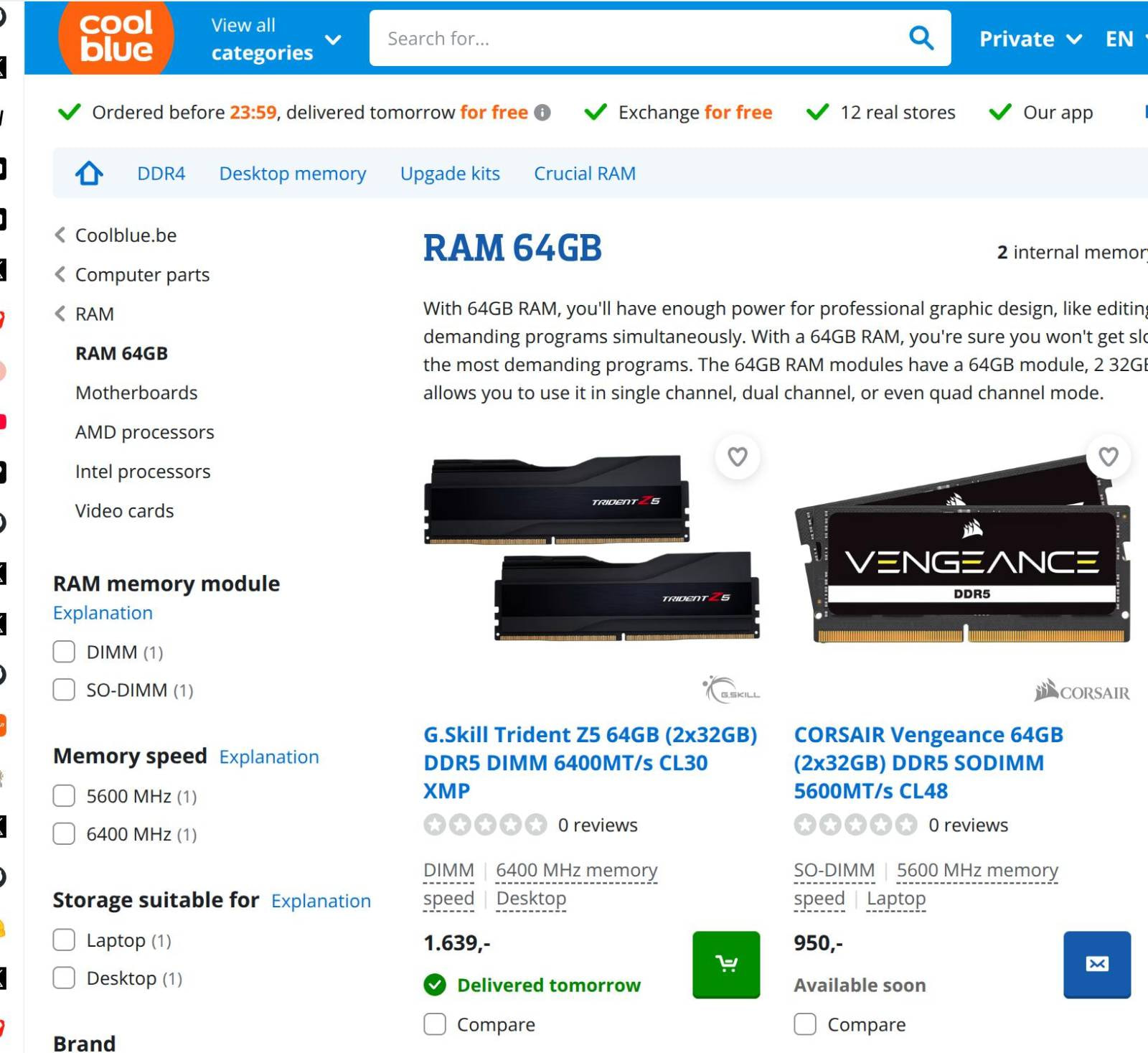
The whole machine is less than the price of 64 GB of DDR5 ram these days, so it is a very budget build.

1 Like

We’ve had a bit of a setback. While trying to setup heavier models, I installed Strata server and a patch so it could work with the older Radeon cards. The patch was however not standard set up to work with 2 GPU’s. On Ubuntu, the system became dangerously unstable, and power surges on the GPU made the machine crash several times. So we decided to start all over and re-install with some code changes suggested by Qwen 3.6 and Big Pickle, some of the medium weight models.
I installed Zorin OS instead of Ubuntu 26.04 - and I let Big Picle handle the entire installation of Strata, including some of the code changes to manage the 2 Radeons and limit the power to the cards. We’ve also had to turn vision off. Default model on Strata is Qwen 3.8 Flash-Next and it was now very stable with 40-60 tokens/second on OpenChamber.
Alberto was able to use the API on his own Framework laptop and OpenChamber.
Next step is to install the swift family models, in particular Swift 1.5, because Qwen 3.8 is a slower thinker. For now, it’s looking good !

1 Like

Time for that writeup? After all, it was truly an adventure!

1 Like