ETHNO MEMO
for ethno check-in tomorrow
Since joining NGI Forward team in July, I have mostly been coding data about co-working so I wanted to take the time to outline some preliminary findings. As the ego network below shows, we are starting to see some themes cohere around co-working. Since the pandemic, there is a growing demand for co-working spaces, including in rural areas with poor Internet connectivity. Co-working spaces, both formal and informal, are springing up to meet the technological and social needs of working remotely as workers relocate all around the world. Some have had to move for care responsibilities while others are relocating to areas in search of better quality of life. Whatever the reason, in the absence of the workplace providing natural space for social interaction, remote workers are seeking a sense of community. Here’s an excerpt that conveys this:

For those operating formalised co-working spaces, their managerial practices of providing safe, clean, and socially distant working environment pose a real difficulty. On one hand, they want their services to last for a long time and see a real opportunity for market growth. However, with talks of the second lockdown and the uncertainty of social distancing guides in some countries, it is difficult to assess whether and how much to invest in operating or expanding facilities (making investment). For the moment, it appears that both the private and public sectors have responded to the demand for communal work spaces, but as the pandemic continues, operators are anticipating different business models for different sectors (distinguishing between sectors).
Some operators are turning to technological solutions like apps to monitor their facilities and regulate members’ access control. This raises some questions about privacy but operators seem to find access control apps to be the most practical option for the moment.
From loss to imagination
Putting co-working in conversation with other semantic nodes (at k=4) begins to tell a complex story about how the shift to online is restructuring social relations:
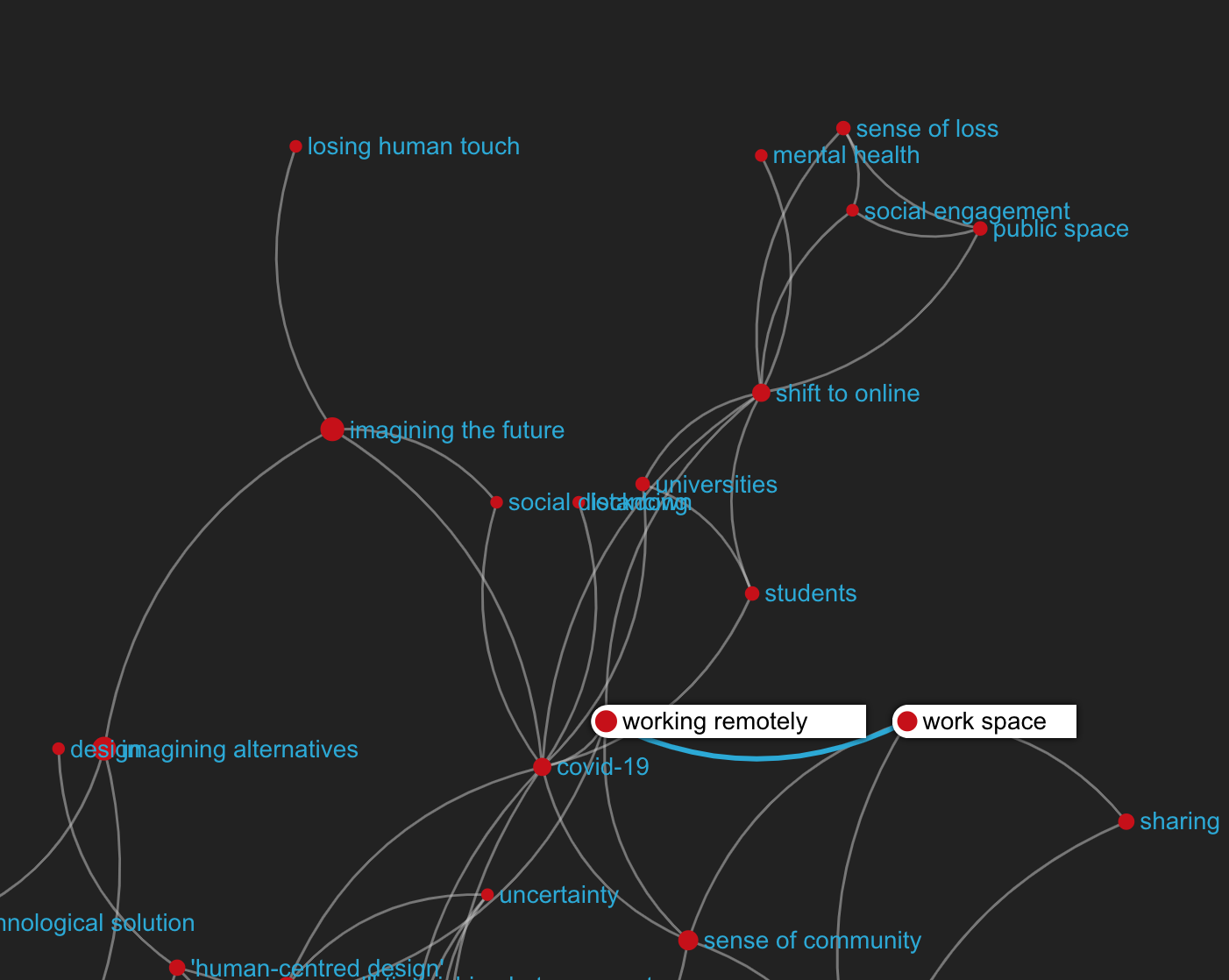
Following the threads around work from COVID-19 captures the double bind of having the pandemic disrupt the fabric of how we organise our working lives. On one hand, there is profound feeling of loss: the connections stemming from shift to online are public space, social engagement, mental health, and sense of loss. For most people, being unable to access public spaces on their own terms has severely restricted their social interaction. The loss of companionship and feeling of community is contributing to erosion in mental health. This was especially prescient with university students as their social and intellectual lives have had to move online.
At the same time, this sense of loss has also generated new opportunities as social distancing measures are propelling participants to think and act more creatively (imagining the future and imagining alternatives). More on this below.
Sharing spaces, building communities
Another strong connection emerging is on how sharing work space is contributing to a sense of community. Sense of community here captures both what co-working space members’ desire and what operators are doing to bring people together.
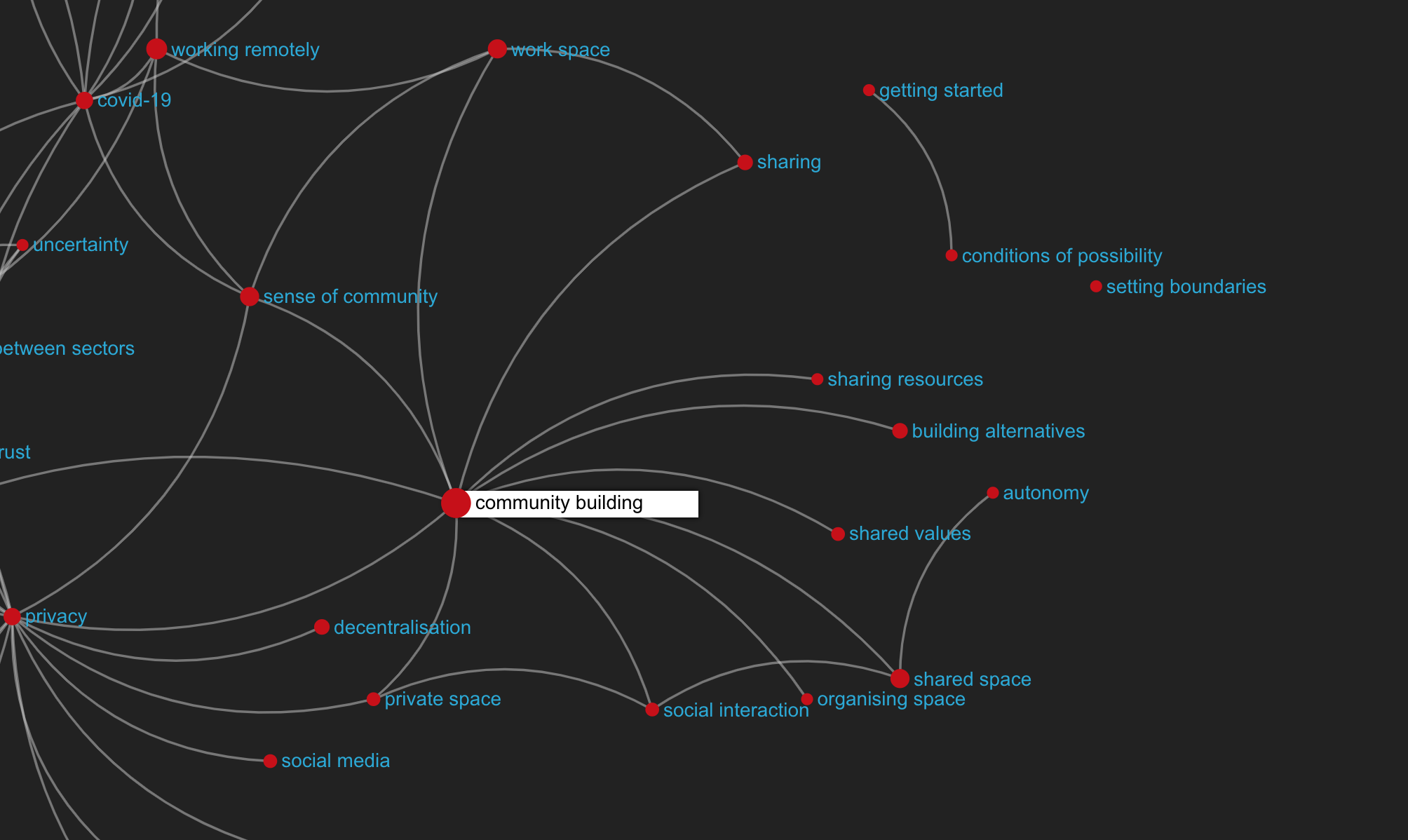
Sharing work space means having to share resources and, on some level, sharing, if not negotiating, values. Unsurprisingly, sharing work spaces with social distancing measures is incentivizing many to set boundaries. This code emerged from participants discussing how the burden of maintaining clean space often falls on those with higher standards of cleaning. (I’ve been having some issues with Graphryder on my computer where some connections are sometimes not shown, as is the case with setting boundaries here. Will discuss this at meeting tomorrow). In one recent thread I coded, a co-working space operator talked about the challenges of organising community-building events when everyone is experiencing 'Zoom fatigue'. Here’s an excerpt from one thread:
How do you bring people together when the one way to connect people is tiring them out? I’ll be keeping track of this dynamic as our participants continue to reflect on the evolving social dynamics of working remotely.