In February I attended a webinar organised by Ted Rau from Sociocracy For All on the topic of “founder dynamics”.
The recording and the slides are publicly available (click on the links).
To be very honest I went into the webinar with a bit of nervousness, because I had some stories and self-blame in my head. In the end however it turned out this was not necessary, because the typical case study which is presented in the webinar is not very applicable to The Reef.
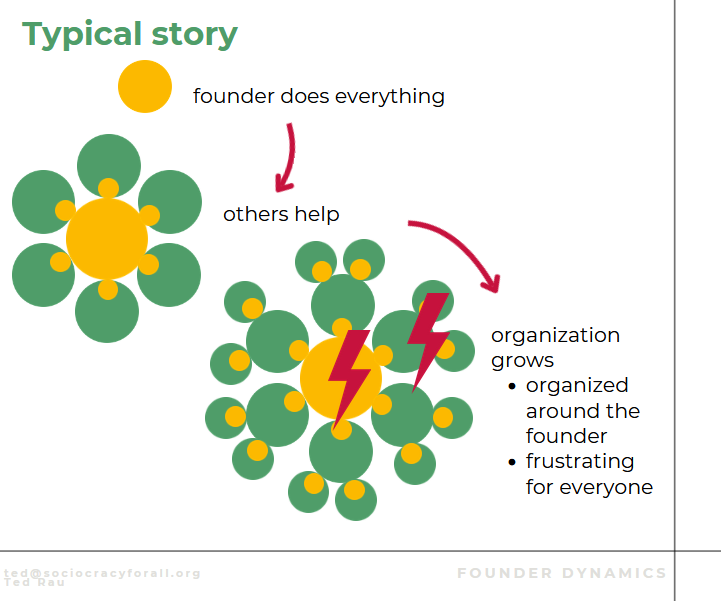
The typical case study that Ted presented is that of an organisation that grows a bit by accident, with a founder who is not interested in setting up an organisational structure and who likes to stay involved in everything. When I say “everything”, it’s really everything: Ted quotes a story of a founder who participated in 50-100 projects. Below is graphical representation, with the founder being the yellow one.
As was to be expected, the webinar leads to the conclusion that one should introduce sociocracy and set up a goverance document, make role descriptions etc, so in that regard I must admit I felt a little proud, and I got freed (a bit) from the guilt and self-blame that I sometimes experience.
Nevertheless I am not going to claim that some of the problems that Ted raises are not applicable to our situation, and I can only recommend to those who are interested in governance or group dynamics to watch the webinar.
It would take me too much time to summarise the whole webinar, but I would like to offer a couple of things that stayed with me:
-
Both sides are part of the problem. One example being micromanagement vs lack of responsibility.
-
Expecting power-over (anticipatory obedience).
-
The organization is likely a direct manifestation of the founder’s strengths and shadows.
-
Passing the baton requires one to give and one to receive.
-
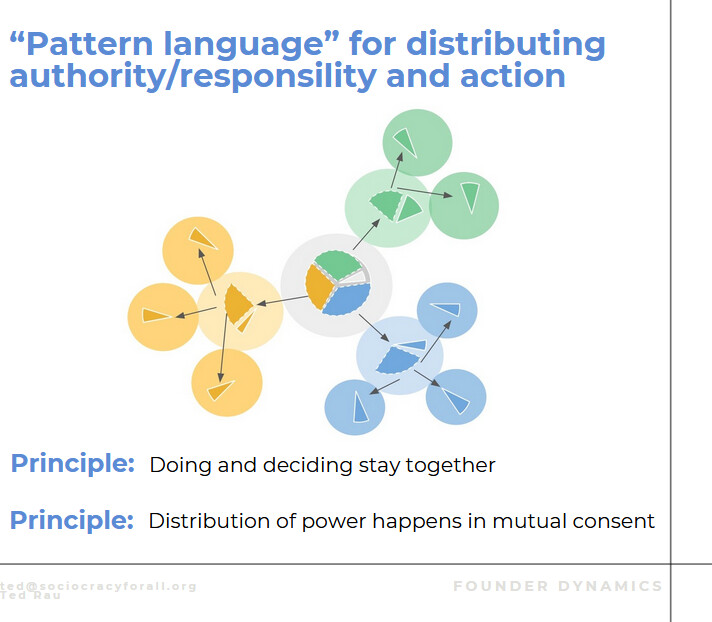
How much we have managed to set up an organisational structure (imperfect as it may be!). Plus definitely also how much more power each Reefling has thanks to the plenary meeting (which does not exist in full sociocracy). See picture below:
The last part, on misconceptions, I found particularly interesting, in particular the one that says “Sociocracy requires to distribute everything” => the slide says it all:
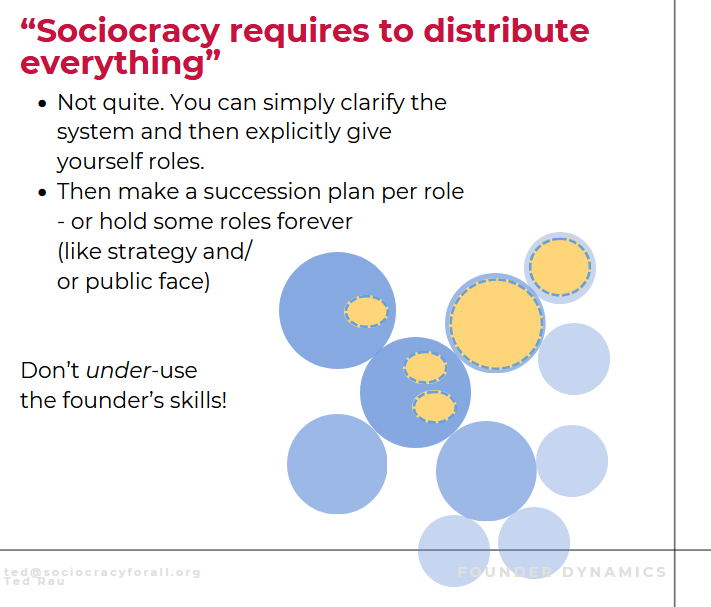
This one resonated with me a lot. Not because I have the ambition to stay in the role of Coordinator until forever and the day after, but more because it confirms to me that - I’ll speak for myself - I got into this with a sort of “fairy tale” image of how a self-managed organisation “should” work, which does not always match with what real-life practices or experts recommend (see also How to manage power and responsibility in a collaborative group).
All in all, for me, the key conclusions were these:
-
Out with the self-blame, in with more pride that we adopted sociocracy from the beginning and set up an organisational structure.
-
Resonating with the “micromanagement vs taking up responsibility” issue.
-
Thinking that the point above this is probably a very normal thing in the growth stage that we are in, and very much looking forward to having a collective discussion about this.
To conclude: I am very aware that I watched this webinar with the eyes of a co-founder and someone who has a very central role in the organisation. I am still feeling a bit vulnerable, so I would be very interested to hear from others now!